Repetition-and-reward principle
Life of PiThe Repetition-and-reward principle is the account of animal learning that underlies Pi Patel’s efforts to train Richard Parker. Its importance lies in the gap between knowing what response is desired and making that response dependable: a tiger does not readily form new associations through reasoning, so survival depends on repeated cues, rewards, and carefully managed circumstances.
Foundations in Animal Behavior
The principle grows out of the book’s description of zookeeping as the management of an animal’s reactions to its surroundings. A keeper tries to reduce an animal’s flight distance through knowledge, food, shelter, and protection. When the animal feels secure, it can remain in place, eat without fuss, behave and socialize naturally, and reproduce. Pi’s father is presented as a keeper with an intuitive eye for animals, attentive to their behavior and able to infer their state of mind.
Training also depends on social position. An animal that does not know where it stands may become nervous, jumpy, and dangerous; rank affects where and when it eats, rests, drinks, and associates with others. But dominance need not be established by brute force. A posture, steady gaze, or other display may intimidate an opponent into backing down. This account of animal behavior helps explain why Pi’s training involves not only rewards but also signals of confidence and boundaries.
Learning Through Repetition and Reward
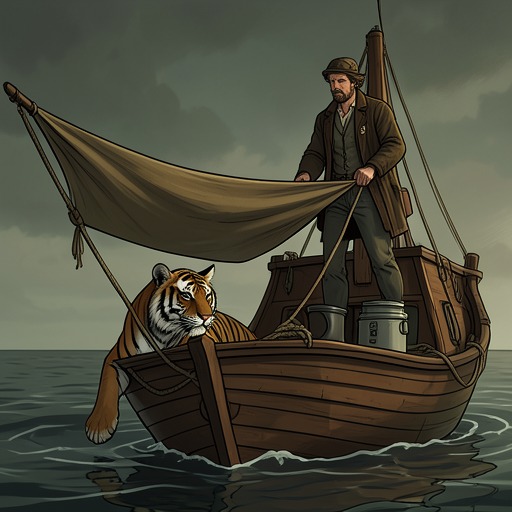
Pi realizes that he must train Richard Parker because the tiger is likely to outlast him, yet the animal is also what keeps him from being left alone with despair. The two are dependent on a shared arrangement: Pi must make Richard Parker’s behavior manageable without provoking an attack. His knowledge as a zookeeper’s son, the whistle hanging from a life jacket, the open sea, and food that can serve as a reward give him the materials for an improvised training routine.
Pi understands that animals act chiefly by instinct or habit and have little capacity to form unfamiliar associations through intelligence alone. Teaching a response therefore requires numbing repetition, and the process depends on both labor and luck. Tiger training is particularly difficult because tigers are less mentally flexible than commonly trained animals such as sea lions and chimpanzees. Pi credits his success in part to Richard Parker’s circumstances: he is a young adult and a pliable omega animal, still tense in a changed environment and therefore unusually ready to comply.
The hoop routine makes the method concrete. Pi fashions a hoop from thin branches and teaches Richard Parker a sequence of four jumps, rewarding each with part of a Meerkat. Pi first holds the hoop about three feet above the ground at the end of his left arm. After Richard Parker jumps through, Pi takes the hoop in his right hand, turns his back, and commands the tiger to return for another jump. For the third leap, Pi kneels and holds the hoop overhead, facing the danger as Richard Parker approaches. Fear never leaves the exercise: Pi cannot be certain the tiger will jump rather than attack, but Richard Parker jumps each time.
The final part of the act is less reliable. Pi throws the hoop so that it rolls like a wheel, expecting Richard Parker to follow it and pass through before it falls. The tiger follows, but sometimes Pi throws poorly and sometimes Richard Parker runs clumsily into the hoop. Even this imperfect response has a practical consequence: it draws the tiger away from Pi. Richard Parker watches the fallen hoop and sniffs it as though it were an animal that had collapsed; Pi gives him the last treat and moves away. The episode shows training as an uneven sequence of cue, response, reward, and retreat—not a sudden mastery of the animal.
Boundaries as Part of Training
Pi’s survival method also draws on territorial behavior. When he needs to provoke an animal without inviting a direct attack, he recommends choosing moderate, regular waves, stabilizing the Lifeboat, preparing a refuge, and protecting the body. He then intrudes noisily at the edge of the animal’s territory, using a consistent sound, while avoiding entry into the animal’s own space. The aim is to make the animal approach or cross a boundary, then respond as though the intrusion matters.
In Pi’s account, backing away slowly while maintaining eye contact can encourage the animal to follow. Once it makes a determined advance into the neutral zone, Pi treats the move as a trespass. He then blows the whistle at full force and sets the sea anchor in motion without delay, making the Lifeboat broadside to the waves if necessary. The routine joins repetition to territory: the whistle is a recognizable signal, while the animal’s movement into the disputed space supplies the occasion for Pi’s response. The method is a calculated attempt to provoke without allowing provocation to become an outright attack.
Renewed Training on the Island
The same problem returns after Pi and Richard Parker reach the island. Richard Parker roams farther afield, marks trees with deep gouges, and gives a hoarse mating call. Pi worries that the tiger’s growing comfort may make him less tolerant of another male in his territory. When they unexpectedly meet in the forest, Richard Parker rears up and threatens Pi three times before moving off. Pi remains frozen until the danger passes, then runs after him with the whistle, trying to make its sound carry across the distance.
That night Pi concludes that he must re-enter the circus ring and train Richard Parker again. He blows the whistle until his lungs hurt, bruises his chest while pounding it, repeats his command thousands of times, and throws hundreds of Meerkat morsels. The detail of repetition is crucial: the island’s abundance of food, water, and space might have made Richard Parker relaxed and harder to influence, but the tiger remains tense and unsettled by the new environment. Pi reads that tension as a continuing willingness—indeed, a need—to oblige.
As Richard Parker’s needs expand, Pi eventually stops spending his nights in the cramped Lifeboat and makes a sleeping place in a tree, using a net, rope, and blankets. The change does not abolish their territorial arrangement; it adapts it to the island. Across the Lifeboat and the island, the principle offers no guarantee of safety or complete control. Its force is more modest and more consequential: by repeating cues, attaching rewards, and managing boundaries, Pi creates workable patterns between himself and an animal whose strength he cannot match.